Keeping your dog’s teeth clean isn’t always easy.
Some dogs happily accept a toothbrush. Others turn every brushing session into a wrestling match.
That’s one reason dental powders, chews, and other convenient products have attracted growing attention.
But convenience and effectiveness aren’t necessarily the same thing.
So, should you choose dental powder or toothpaste for your dog?
What Is Dog Dental Powder?
Dental powders are products designed to be added to a dog’s food.
Their ingredients and intended mechanisms vary by product. Some are marketed for plaque or tartar control, while others focus on breath odor.
Because formulas differ, it’s important not to assume that all dental powders provide the same benefits.
Check the product’s ingredients, instructions, age restrictions, and evidence supporting its claims.
How Does Dog Toothpaste Work?
Dog toothpaste is designed to be used with an appropriate toothbrush or finger brush.
The physical brushing action helps remove plaque from accessible tooth surfaces.
Use toothpaste formulated for dogs, not human toothpaste. Some human oral-care ingredients can be harmful to pets if swallowed.
For many dogs, gradual training is the key to making brushing manageable.
Start by gently introducing mouth handling, reward cooperation, and progress slowly.
Dental Powder vs. Toothpaste: Key Differences
| Feature | Dental powder | Dog toothpaste with brushing |
|---|---|---|
| Application | Added to food | Applied during brushing |
| Owner effort | Usually lower | Requires regular handling |
| Mechanical plaque removal | No brushing action | Yes |
| Effectiveness | Depends on the specific product | Supported by the mechanical cleaning action |
| Best use | Possible supplement | Core home-care technique when tolerated |
Does Dental Powder Actually Work?
Some individual dental products have supporting evidence, but effectiveness cannot be inferred simply because a product is labeled natural, enzymatic, or veterinarian recommended.
A useful starting point is the Veterinary Oral Health Council (VOHC).
Its accepted-products list identifies products that have met its requirements for specific plaque or tartar control claims.
A product without the VOHC Seal is not automatically ineffective. However, strong marketing claims alone are not proof of effectiveness.
Before buying, check whether the exact product and formulation appear on the accepted list, and what claim the seal covers.
What About Dental Chews?
Dental chews can be useful as part of a broader oral-care routine.
Choose products appropriate for your dog’s size and chewing behavior, supervise use, and consider the calories added to their diet.
Not every chew provides proven dental benefits.
Which Option Should You Choose?
If your dog tolerates toothbrushing, that is generally the best starting point for a home dental-care routine.
If brushing is difficult, ask your veterinarian which supplementary products might be appropriate.
A dental powder may be more convenient, but convenience alone should not determine your choice.
Signs Your Dog Needs Veterinary Dental Care
Contact your veterinarian if you notice:
- Persistent bad breath.
- Bleeding or inflamed gums.
- Loose or broken teeth.
- Difficulty chewing.
- Facial swelling.
- Signs of mouth pain.
Home products cannot remove established hardened tartar in the same way as professional veterinary dental treatment.
Compare ongoing costs, not just the package price
Compare the labelled daily serving and how long a package lasts for your dog’s weight. Powders and chews can create a recurring cost; brushing also requires replacement toothpaste and brushes. No prices are quoted here because sizes and retailer prices change.
Final Verdict
Dog dental powder and toothpaste are not necessarily interchangeable.
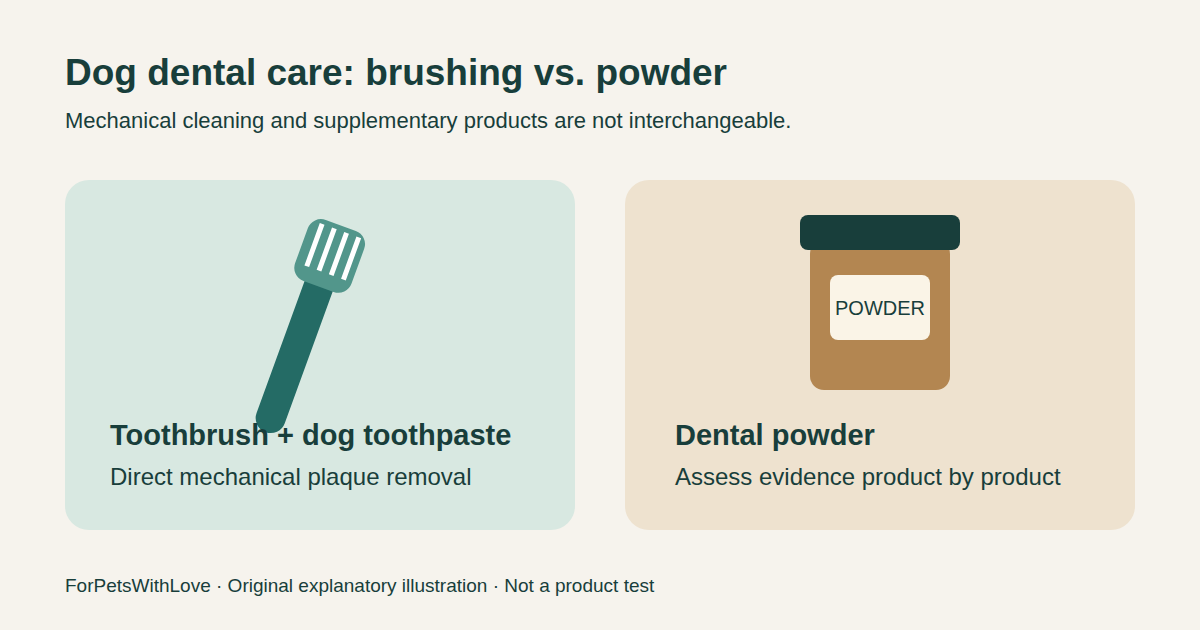
Toothbrushing provides direct mechanical cleaning. Dental powders should be assessed product by product and may have a supplementary role.
The best dental-care routine is one that combines appropriate home care, veterinary guidance, and regular oral-health assessment.
Helpful Resource
Review the “VOHC Accepted Products List” (https://vohc.org/accepted-products/) before comparing individual dental products.
Editorial note: This article is educational and is not a substitute for veterinary diagnosis or treatment.