Living with pets means living with a little extra fur, dust, and the occasional unpleasant smell.
If you’ve been considering an air purifier, you’ve probably seen promises about removing pet hair, allergens, and odors.
But can one machine really solve all three problems?
The answer depends on what you’re trying to remove.
1. Can Air Purifiers Remove Pet Hair?
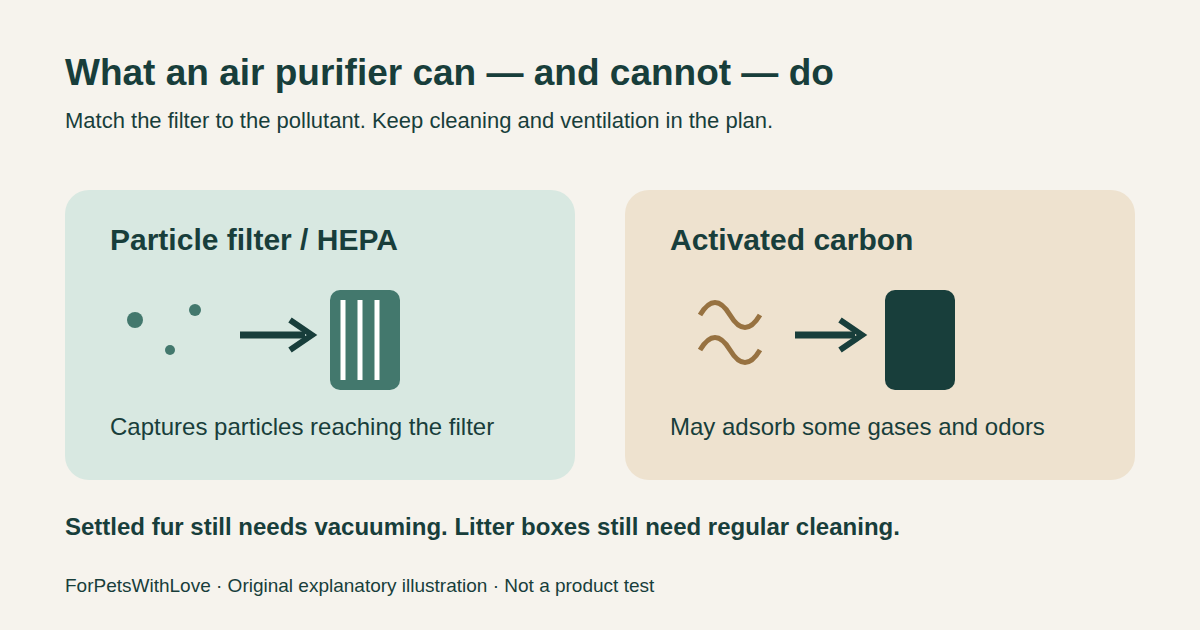
Air purifiers can capture some airborne hair and particles, but they won’t remove fur that’s already settled on your couch, carpets, or floors.
Larger pet hairs tend to settle relatively quickly.
For visible fur, regular vacuuming, grooming, and washable furniture covers usually remain essential.
An air purifier is better viewed as an addition to your cleaning routine—not a replacement for it.
2. What About Pet Dander?
Pet dander consists of small particles shed from animals’ skin.
Some dander-related material can become airborne, making particle filtration relevant.
Air purifiers with effective particle filters may reduce airborne particles, but they cannot remove all allergens from a home.
For households with allergies, outcomes vary. A purifier should not be presented as a guaranteed treatment or cure.
3. Can Air Purifiers Remove Litter Box Odors?
This is where filtration technology matters.
HEPA filters primarily capture particles. They are not designed to remove gaseous odor compounds.
Activated carbon and other specialized media may help with some odors, depending on the material, amount of filter media, and pollutants involved.
Even a good purifier won’t replace daily litter-box maintenance.
Remove waste regularly, clean the box appropriately, and ensure your cat has a suitable, comfortable toileting environment.
4. What Should Pet Owners Look For?
When comparing air purifiers, consider:
HEPA or effective particle filtration: Useful for removing airborne particles.
CADR (Clean Air Delivery Rate): Helps assess how much filtered air a device can deliver, relative to room size.
Activated carbon: Relevant when odors are a major concern, although results vary.
Replacement filter costs: An inexpensive purifier may become expensive to maintain.
Noise: A quiet operating mode matters when the machine runs in a bedroom or living room.
Ozone: Avoid devices that intentionally produce ozone.
5. Where Should You Place an Air Purifier?
Choose a room where you and your pets spend significant time.
Leave adequate space around the unit for airflow and follow the manufacturer’s placement instructions.
Keep cables secured and make sure pets cannot knock over or interfere with the device.
6. Do You Really Need One?
An air purifier may be worth considering if airborne particles are an ongoing concern.
But if your main problem is fur covering the sofa, a vacuum cleaner and regular grooming may deliver more noticeable results.
If litter odors are the problem, start with litter hygiene and suitable ventilation.
Identify the problem first, then choose the equipment.
Final Thoughts
Air purifiers can be useful in pet-friendly homes, but they aren’t magical fur-removal machines.
The right model depends on your room size, the pollutants you want to address, operating noise, and ongoing filter costs.
Before buying, compare verified performance specifications rather than relying on labels such as “perfect for pets.”
Frequently Asked Questions
Do HEPA air purifiers remove cat hair?
They may capture hair that reaches the filter, but they won’t clean settled fur from furniture or floors.
Will an air purifier eliminate cat litter smell?
Not necessarily. Appropriate gas-adsorbing filters may reduce some odors, but litter-box hygiene remains essential.
Are air purifiers safe around pets?
Choose models with appropriate safety features and avoid intentional ozone generation. Follow installation and maintenance instructions.