faq:
- question: “Where should I put a scratching post in a small apartment?” answer: “Focus on high-impact locations: near furniture your cat scratches, by windows for visual stimulation, next to sleeping areas for morning stretches, and in main living areas where you spend time. In small spaces, vertical posts are your friend—they use height instead of floor space. Corner scratchers are also excellent for tight spaces.”
- question: “How many scratching posts do I need in a small apartment?” answer: “Even in small apartments, follow the N+1 rule: number of cats plus one. For one cat, aim for at least 2-3 scratching posts. Place them strategically rather than clustering them together. One near sleeping areas, one near problem furniture, and one in a main living area is a good starting point.”
- question: “What type of scratching post works best in small apartments?” answer: “Vertical posts are ideal for small spaces because they use height rather than floor space. Look for tall, narrow posts with stable bases. Corner scratchers are perfect for utilizing unused corner space. Wall-mounted scratchers are another great option—they take up zero floor space and can be placed at various heights.”
- question: “Can I use wall-mounted scratchers in a rental apartment?” answer: “Yes, but check your lease first and use removable adhesive options rather than permanent mounting. Many wall-mounted scratchers come with removable adhesive strips or can be mounted with command strips. These allow you to enjoy the benefits without damaging walls or violating lease terms.”
- question: “How do I fit scratching posts in a studio apartment?” answer: “In studio apartments, think vertically and use multi-functional furniture. Tall scratching posts can double as climbing structures. Place posts near windows or in corners where they don’t disrupt flow. Consider scratchers that attach to furniture or walls to save floor space. Every inch counts, so choose pieces that serve multiple purposes.”
- question: “What if my landlord doesn’t allow cat furniture?” answer: “Focus on discreet, minimal scratching options that don’t look like traditional cat furniture. Many modern scratching posts are designed to blend with home decor. Wall-mounted scratchers can be nearly invisible when not in use. You can also use scratching pads that tuck under furniture or sit unobtrusively in corners.” howto:
- name: “Assess Your Space” text: “Map out your apartment and identify available corners, wall spaces, and vertical opportunities”
- name: “Prioritize High-Impact Locations” text: “Place posts near scratched furniture, windows, and sleeping areas first”
- name: “Choose Space-Efficient Designs” text: “Select vertical posts, corner scratchers, and wall-mounted options”
- name: “Use Multi-Functional Pieces” text: “Combine scratching with climbing, perching, or storage functions”
- name: “Optimize Placement” text: “Position posts where they don’t disrupt traffic flow or feel cramped” products:
- name: “SmartCat Ultimate Scratching Post” price: “49.99” currency: “USD” url: “https://www.amazon.com/dp/B0006N9I5M?tag=forpetswith07-20" image: images/smartcat-scratching-post.jpg
- name: “PetFusion 3-Sided Vertical Scratcher” price: “34.99” currency: “USD” url: “https://www.amazon.com/dp/B00J4I6J2I?tag=forpetswith07-20" image: images/petfusion-scratcher.jpg
- name: “Frisco 32-inch Scratching Post” price: “29.99” currency: “USD” url: “https://www.amazon.com/dp/B07Z5K5Q3V?tag=forpetswith07-20" image: images/frisco-scratching-post.jpg
Cat Scratching Post Placement Guide for Small Apartments
Living in a small apartment with a cat presents unique challenges. You want to provide everything your feline friend needs, but you’re working with limited square footage. Every piece of furniture must earn its place, and traditional cat furniture can feel like it takes up more space than you can spare.
The good news is that smart scratching post placement can protect your furniture and keep your cat happy without overwhelming your limited space. With strategic thinking and the right choices, you can create a cat-friendly environment that feels spacious rather than cramped.
Let’s explore how to maximize your small apartment with scratching solutions that work for both you and your cat.
The small apartment advantage
Why small spaces can work well
Believe it or not, small apartments actually offer some advantages for scratching post placement. The limited space means your cat’s territory is concentrated, making it easier to cover key areas with fewer scratching posts. You don’t need posts in every room when you only have a few rooms to begin with.
Small apartments also force you to be intentional about placement. Every decision counts, which often leads to better, more strategic choices rather than scattering posts randomly throughout a larger home.
The vertical thinking approach
In small spaces, think vertically rather than horizontally. Your apartment has height that you can utilize for scratching posts, climbing structures, and perches. Tall, narrow scratching posts take up minimal floor space while providing maximum functionality for your cat.
This vertical approach not only saves floor space but also appeals to cats’ natural desire to climb and survey their territory from above. A tall scratching post can serve multiple purposes—scratching surface, climbing structure, and observation perch all in one.
Multi-functional solutions
Small apartments demand multi-functional furniture, and cat furniture is no exception. Look for scratching posts that also serve as climbing trees, perches, or even storage pieces. The more functions a single piece can serve, the more valuable it becomes in your limited space.
Some scratching posts come with built-in hiding spots, toys, or platforms. Others can be integrated with existing furniture or serve as room dividers. These multi-functional pieces provide excellent value in small apartments.
Strategic placement zones
Zone 1: The sleeping area
Every cat needs a scratching post near where they sleep. Cats naturally stretch and scratch after waking up, so having a post within easy reach of their bed is essential.
In a small apartment, this might mean placing a scratching post next to your bed if your cat sleeps with you, or near their favorite napping spot. Look for tall posts that allow for full-body stretching—32 inches or taller is ideal.
If floor space is extremely limited, consider a wall-mounted scratcher near the sleeping area. These take up zero floor space and can be positioned at the perfect height for your cat’s morning stretches.
Zone 2: The window area
Windows are prime real estate in any apartment, both for you and your cat. Cats love watching the world outside, and the excitement of birds, squirrels, or passing cars often triggers scratching behavior.
Place a scratching post near your best window. If you have a window seat or perch, position a post nearby so your cat can scratch when they’re stimulated by outdoor activity. This combination of visual stimulation and scratching opportunity is incredibly appealing to cats.
In small apartments, windows often become the main entertainment center for cats. Make this area as cat-friendly as possible with appropriate scratching surfaces.
Zone 3: The main living area
Your main living area—whether it’s a living room, family room, or combined space—needs at least one scratching post. This is where you and your cat spend the most time together, and it’s a prime territory-marking location.
Place a scratching post near your main seating area, ideally within a few feet of furniture your cat might be tempted to scratch. This proximity makes redirection natural and easy.
Choose a post that fits your decor and doesn’t feel intrusive in your main living space. Many modern scratching posts are designed to blend seamlessly with contemporary interiors.
Zone 4: The entryway
Entryways are psychologically significant for cats. They mark the transition between outside and inside, and cats often feel the need to scratch in these areas to establish territory.
Even in a small apartment, your front door area can accommodate a scratching post. Look for narrow, vertical posts that fit in corners or along walls without blocking traffic. Corner scratchers are particularly good for entryways.
If you have absolutely no floor space near the door, consider a wall-mounted scratcher at cat height. This provides the territory-marking function without taking up valuable floor space.
Space-saving scratching solutions
Vertical posts
Vertical scratching posts are the gold standard for small apartments. They use height rather than floor space, making them perfect for tight quarters. Look for posts that are tall and narrow with stable bases.
A good vertical post should be at least 32 inches tall to allow for full-body stretching. The base should be wide enough to prevent tipping, but not so wide that it dominates your floor space.
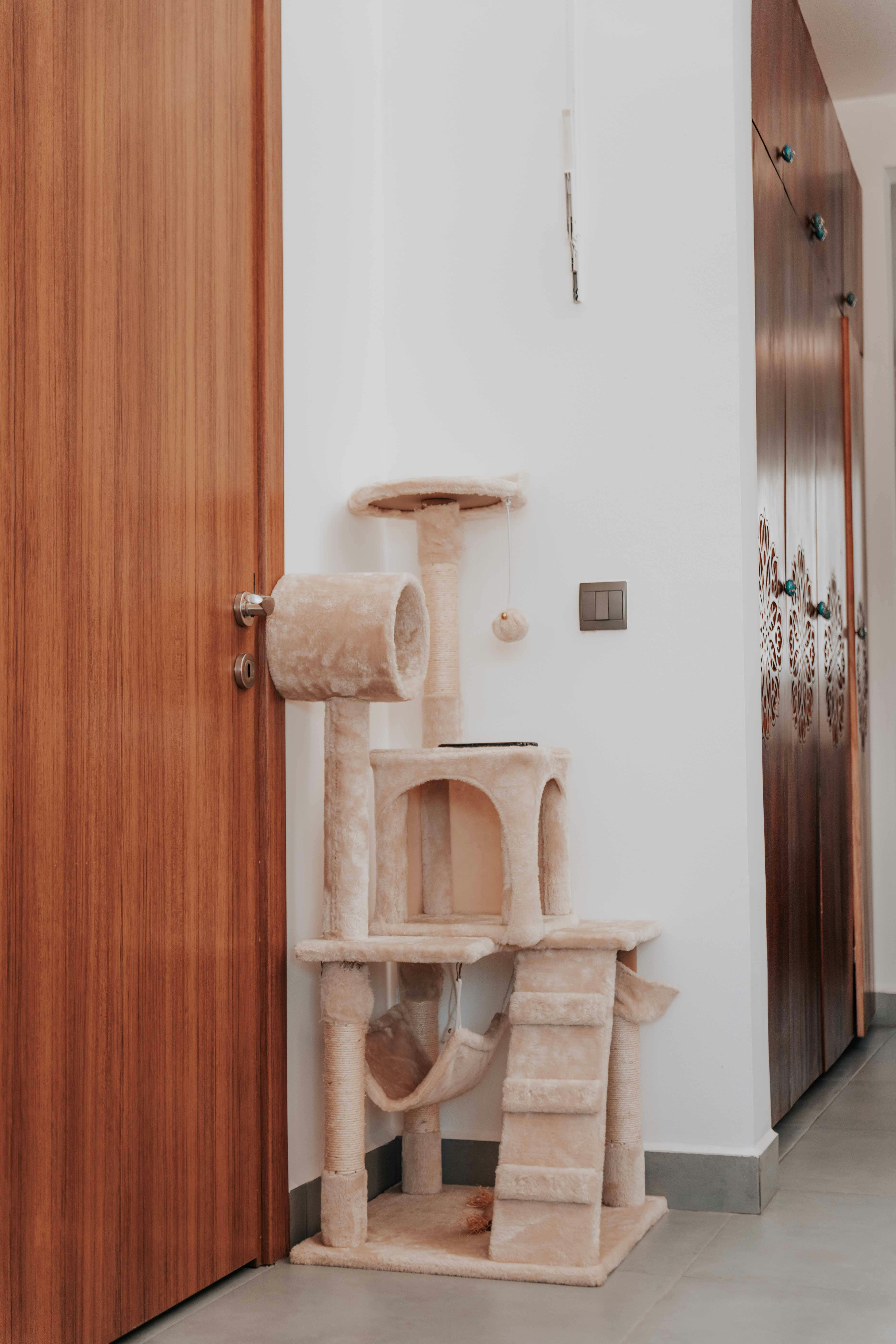
Some vertical posts come with multiple levels or platforms, adding climbing and perching opportunities without increasing the footprint. These multi-level posts are excellent value in small spaces.
Corner scratchers
Corners are often wasted space in apartments, but they’re perfect for scratching posts. Corner scratchers fit snugly into unused corners, providing scratching surfaces without disrupting your room’s flow.
Look for triangular or wedge-shaped scratchers designed specifically for corners. Some are vertical posts that fit in corners, while others are horizontal pads that sit on the floor. Both types are excellent space-savers.
Corner placement also has the advantage of being naturally stable—the walls provide support, reducing the risk of tipping during enthusiastic scratching.
Wall-mounted options
Wall-mounted scratchers are the ultimate space-saving solution. They take up zero floor space and can be positioned at various heights to suit your cat’s preferences.
These scratchers attach directly to walls and can be placed anywhere you have wall space. Some are simple pads, while others are more elaborate with multiple levels or integrated perches.
For rental apartments, look for wall-mounted scratchers that use removable adhesive strips rather than permanent mounting. This allows you to enjoy the benefits without damaging walls or violating lease terms.
Door-mounted scratchers
Don’t overlook your doors as potential scratching surfaces. Door-mounted scratchers hang over the top of doors and provide vertical scratching surfaces without using any floor or wall space.
These are particularly good for bedrooms, bathrooms, or closet doors where you might not have other scratching options. They’re easy to install and remove, making them perfect for renters.
Furniture-integrated scratchers
Some scratching posts are designed to integrate with existing furniture. These might attach to the sides of sofas, sit underneath tables, or serve as room dividers with scratching surfaces.
Furniture-integrated scratchers are excellent for small apartments because they don’t add any additional footprint. They make use of furniture you already have, turning potential scratching targets into appropriate scratching surfaces.
Optimizing your layout
Create scratching zones
Rather than scattering scratching posts randomly, create designated scratching zones in your apartment. Each zone should include at least one scratching surface along with other cat-friendly elements like perches, toys, or hiding spots.
In a small apartment, you might have 2-3 scratching zones total. One near the sleeping area, one near the window, and one in the main living area. This focused approach is more effective than trying to cover every possible location.
Consider traffic flow
Place scratching posts where they don’t disrupt the flow of movement through your apartment. Avoid high-traffic pathways where posts might become tripping hazards or feel cramped.
Corners, along walls, and behind furniture are all good locations that don’t interfere with movement. Think about how you move through your space and place posts accordingly.
Use vertical space strategically
In addition to tall scratching posts, consider other vertical elements like wall shelves, perches, or climbing structures. These can be positioned near scratching posts to create vertical cat highways that maximize your apartment’s height.
Vertical space is often underutilized in small apartments, but it’s incredibly valuable for cats. The more vertical opportunities you provide, the more enriched your cat’s environment will be.
Think multi-functionally
Every piece in your small apartment should serve multiple functions when possible. A scratching post might also be a climbing tree, a perch, or even a room divider. A window area might combine a scratching post with a perch and a bird feeder.
This multi-functional approach reduces the total number of pieces you need while still providing everything your cat requires. It’s the most efficient way to create a cat-friendly environment in limited space.
Special considerations for different apartment types
Studio apartments
Studio apartments present the biggest challenge because all your living functions happen in one room. The key here is to create distinct zones within the open space.
Place a scratching post near your sleeping area, another near the window, and a third near your main seating or work area. Use furniture placement to create visual separation between zones, even if the space is open.
Consider a tall, multi-level scratching post that serves as a room divider between different functional areas. This provides scratching surfaces while also helping to define your space.
One-bedroom apartments
One-bedroom apartments offer more flexibility because you have separate rooms. Place at least one scratching post in the bedroom near the sleeping area, and 1-2 in the main living area.
The bedroom post can be smaller since it’s primarily for morning stretches. The living area posts should be more substantial and strategically placed near furniture and windows.
Apartments with balconies
If you have a balcony, consider it as an extension of your living space. A weather-resistant scratching post on the balcony can provide outdoor scratching opportunities and protect your indoor furniture.
Even if you can’t place a full post on the balcony, a scratching pad or mat can work well. Just make sure any outdoor scratching surfaces are protected from the elements.
Maintenance and organization
Keep it clean
In small apartments, cleanliness is especially important. Scratching posts can accumulate dust, dirt, and debris over time, which might make them less appealing to your cat.
Regularly vacuum or shake out scratching posts to remove loose fibers and debris. Wipe down any solid surfaces with a damp cloth. A clean scratching post is more appealing and lasts longer.
Rotate and refresh
If you have multiple scratching posts, consider rotating their positions occasionally. This can keep your cat interested and prevent any one post from becoming overused in one spot.
You can also refresh posts by adding catnip, replacing worn scratching surfaces, or repositioning toys. Small changes can renew your cat’s interest in existing posts.
Declutter regularly
In small apartments, clutter can make spaces feel even smaller and can interfere with scratching post placement. Regularly declutter to keep your space open and functional.
Pay special attention to areas around scratching posts. Make sure they’re accessible and not blocked by clutter. Your cat needs clear access to scratching surfaces for them to be effective.
Storage solutions
Use storage solutions that don’t interfere with scratching post placement. Under-bed storage, wall-mounted shelves, and multi-functional furniture with built-in storage can help keep your apartment organized without encroaching on cat spaces.
The more organized your apartment, the more space you’ll have for appropriate scratching surfaces. Good organization and cat-friendly design go hand in hand.
Building a cat-friendly small apartment
Creating a cat-friendly environment in a small apartment is entirely possible with strategic thinking and smart choices. Focus on vertical space, multi-functional pieces, and strategic placement rather than trying to cram in traditional cat furniture.
Remember that quality matters more than quantity. A few well-placed, high-quality scratching posts are more effective than many poorly placed ones. Think about your cat’s needs and your space limitations, and find solutions that work for both.
Small apartment living with cats can be wonderful. Your cat will enjoy the cozy environment, and you’ll appreciate the companionship without feeling overwhelmed by cat furniture. With the right approach, you can have a happy cat and a comfortable, stylish home.
Affiliate Disclosure: When you buy through links on our site, we may earn a commission at no extra cost to you. This helps us continue providing free, high-quality pet care content.
Medical Disclaimer: Always consult with a veterinarian for medical advice. This article is for informational purposes only.